
Pura Luhur Uluwatu stands on a cliff edge about 70 metres above the Indian Ocean at the south-western tip of the Bukit, and it is one of the most important sea temples in Bali. Most visitors come in the late afternoon, walk the clifftop paths, and then stay for the Kecak fire dance, performed in an open-air amphitheatre as the sun drops into the sea. It is one of the essential evenings of any trip to Bali, but it is also one of the busiest, so a little planning makes a big difference.
 Pura Luhur Uluwatu sits on the cliff edge about 70 metres above the sea. Photo: Aleksandr Zykov / Flickr, CC BY-SA 2.0
The short version
- Temple hours: generally 7am to 7pm daily.
- Temple entry: recently around IDR 50,000 to 60,000 for international adults and IDR 30,000 to 40,000 for children, cash. Check before you go.
- Kecak dance: a sunset performance of about an hour, with tickets recently around IDR 150,000 for adults (children cheaper). The temple entry fee is paid separately.
- Arrive by about 4.30 to 5pm to walk the cliffs, buy tickets and get a good seat.
- Put away sunglasses, hats, phones and anything loose. The temple monkeys are expert thieves.
About the temple
Pura Luhur Uluwatu is one of Bali's sad kahyangan jagat, the key temples believed to protect the island, and is dedicated to guarding Bali from the forces of the sea. The inner sanctum is reserved for worshippers, so visitors stay on the paths and terraces around it, but the setting is the real draw: limestone cliffs dropping sheer to the ocean, with views north along the coast towards the Uluwatu surf break.
Paths run along the cliff top in both directions from the main gate. The southern side has the classic views back to the temple perched on its headland. The walk is mostly paved with some steps, and there is little shade, which is another reason to come later in the day.
The temple is an active place of worship. During ceremonies some areas may be closed, and you may see processions and offerings; give worshippers space and do not walk in front of people praying.
Tickets, fees and opening hours
The temple is generally open from 7am to 7pm. The entry fee, payable at the ticket office by the car park, was recently quoted at IDR 60,000 for international adults and IDR 40,000 for children aged 4 to 12, with lower prices for Indonesian citizens; other recent sources quote IDR 50,000 and IDR 30,000. Parking is a small extra charge. Bring cash, and check the current price before you go.
The Kecak dance has its own ticket. On-site tickets have recently been about IDR 150,000 for adults and about IDR 75,000 for children, sold at the box office near the amphitheatre from late afternoon. You can also book online in advance through ticket resellers and tour platforms, which is useful in peak season, but you will still need to pay the temple entry fee on arrival. Many tours bundle transport, entry and the Kecak ticket together.
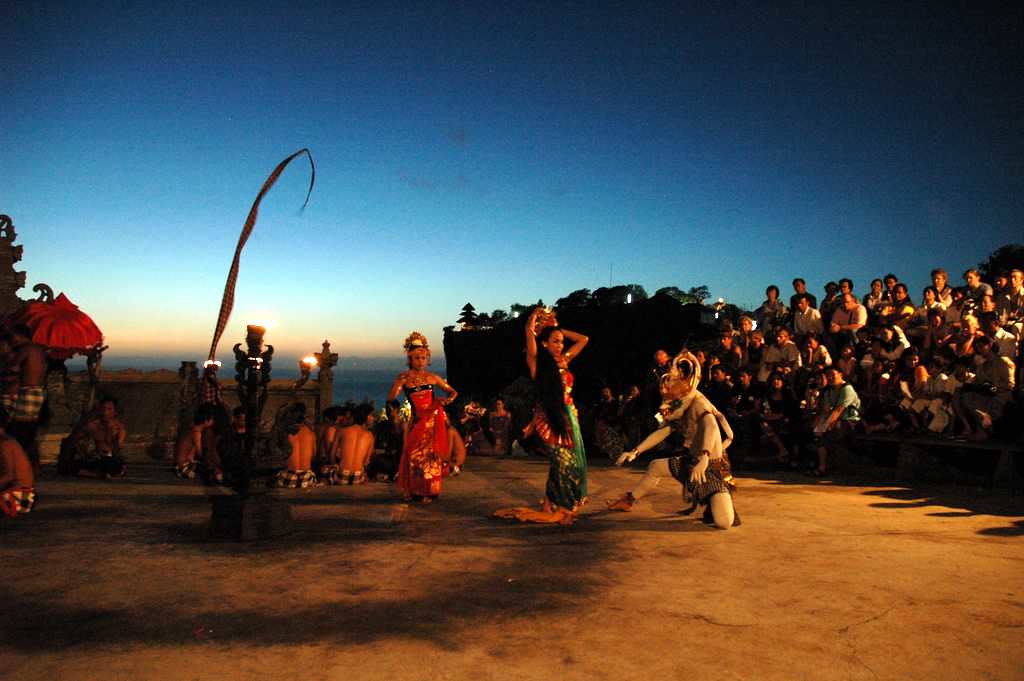 The Kecak performance in the clifftop amphitheatre as the light fades. Photo: sektordua / Flickr, CC BY 2.0
The Kecak fire dance
Kecak is a dance drama with no instruments. A circle of several dozen bare-chested men provides the soundtrack, chanting the rhythmic "cak-cak-cak" that gives the dance its name, while costumed dancers act out scenes from the Ramayana: the abduction of Sita, the search led by Rama, and the mischievous white monkey Hanuman, who usually steals the show and ends up in a ring of burning coconut husks. At Uluwatu it is performed in an open-air amphitheatre on the cliff edge, timed so that the sun sets behind the dancers.
The performance lasts about an hour without an interval. It has traditionally started at around 6pm, and at busy times a second show has been added later in the evening; check the time on the day, especially in the wet season, when sunset is a little later. A short synopsis in English is usually handed out with your ticket. Our Kecak Fire Dance listing has the latest details we have.
Where to sit
- Seating is unreserved: first come, first served. Arriving around 4.30pm gives you a good choice.
- The top rows in the centre give the best overall view of the dancers and the sunset, and you can lean against the back wall.
- The front rows put you close to the action, including the fire, but they are hot and smoky.
- For the sunset show, some upper rows on the far side get more shade.
- It is a hard stone bench; a small cushion or sarong to sit on helps.
What to wear
As at any Balinese temple, legs and shoulders should be covered. If you arrive in long trousers or a long skirt, you will usually be given a sash to tie at the waist; if your legs are exposed, staff will lend you a sarong at the entrance. Avoid beachwear and bikini tops, and wear shoes you can walk in on uneven paths.
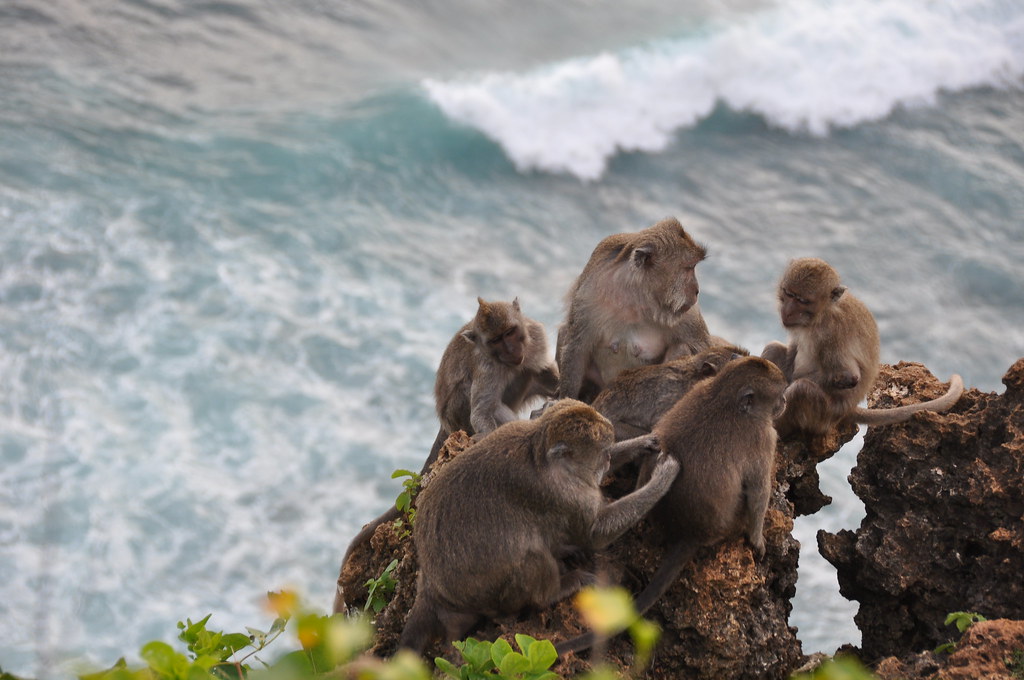 Uluwatu's long-tailed macaques on the cliffs below the temple. Photo: Marufish / Flickr, CC BY-SA 2.0
The monkeys
Long-tailed macaques live in the forest around the temple, and the Uluwatu troop is notorious for snatching sunglasses, hats, phones, earrings, flip-flops and food, then waiting to "trade" them back for a treat. Before you go in:
- Put sunglasses, hats and jewellery in a zipped bag, and keep your phone in your hand or a zipped pocket.
- Do not carry food or drink in the open, and do not feed the monkeys.
- Keep a little distance, avoid staring at them, and do not try to grab anything back.
- If something is taken, ask a member of the temple staff for help rather than chasing the monkey.
Getting there and avoiding the crush
The temple is at the end of the road south from the Uluwatu clifftop, roughly 10 to 15 minutes from Padang Padang or Bingin in normal traffic, and much longer from Jimbaran, Nusa Dua or the rest of Bali in the late afternoon. Most people arrive between 4pm and 6pm and leave as soon as the show ends, so the road can be gridlocked in both directions.
- By scooter: the easiest way in and out, and there is motorbike parking by the gate. Wear a helmet and carry your licence.
- By car: hire a driver who will wait for you, or take a Grab or Gojek there and be prepared to wait for a pick-up afterwards. Some drivers wait outside the car park because of the traffic.
- If you are staying in Seminyak, Canggu or Ubud, consider an organised tour, which often combines the temple with a beach or dinner in Jimbaran.
Before and after: food and sunset alternatives
After the show, many people head to Jimbaran Bay for seafood on the sand at places such as Menega Cafe, or stay closer to the cliffs for dinner along the Uluwatu road. If you would rather avoid the Kecak crowds, the clifftop bars above Suluban, including Single Fin and Ulu Cliffhouse, are classic sunset spots; see our guide to bars and sunset spots. Another cultural option on the peninsula is the Garuda Wisnu Kencana Cultural Park above Ungasan.
Plan the rest of your trip
Uluwatu Temple is on the doorstep of the Uluwatu and Suluban clifftop and a short ride from Padang Padang and Ungasan. See the Uluwatu Temple listing, browse more things to do, or find somewhere to stay nearby on the Uluwatu map.
Last checked in November 2026. Entry fees, Kecak ticket prices and show times change, so check before you go.

